"Your mind is for having ideas,
not holding them."
– David Allen
What is GTD?
If you have a lot to manage and can't seem to get ahead of it, the problem probably isn't your tools. Most people already have a planner, a task manager, maybe even an AI assistant, and still feel behind. What's missing isn't another app. It's a reliable way to think about and act on everything that has your attention.
GTD (Getting Things Done®) is a proven productivity method that helps you capture, organize, and take action on everything that has your attention.
Since 2001, GTD has helped business leaders, managers, working parents, and early-career professionals improve focus and reduce overwhelm, both at work and in life.
But no tool alone can do that. If you have big goals and a lot to manage, what you really need is a reliable way to stay focused and move forward with clarity.
Why GTD?
GTD works because it gets things out of your head. Every unfinished task, open question, or unresolved commitment occupies mental space, even when you're not actively thinking about it. Psychologists call this the Zeigarnik effect: your brain keeps open loops active in the background, quietly draining your focus and energy until they're resolved.
By capturing everything in a trusted system outside your mind, you close those loops. Not by finishing everything, but by deciding what each thing means and where it belongs. That decision is what frees your attention.
The result isn't just better organization. It's a different relationship with your work. Instead of reacting to whatever feels loudest, you choose what gets your attention, and you do it with confidence, because you know nothing important is slipping through the cracks.
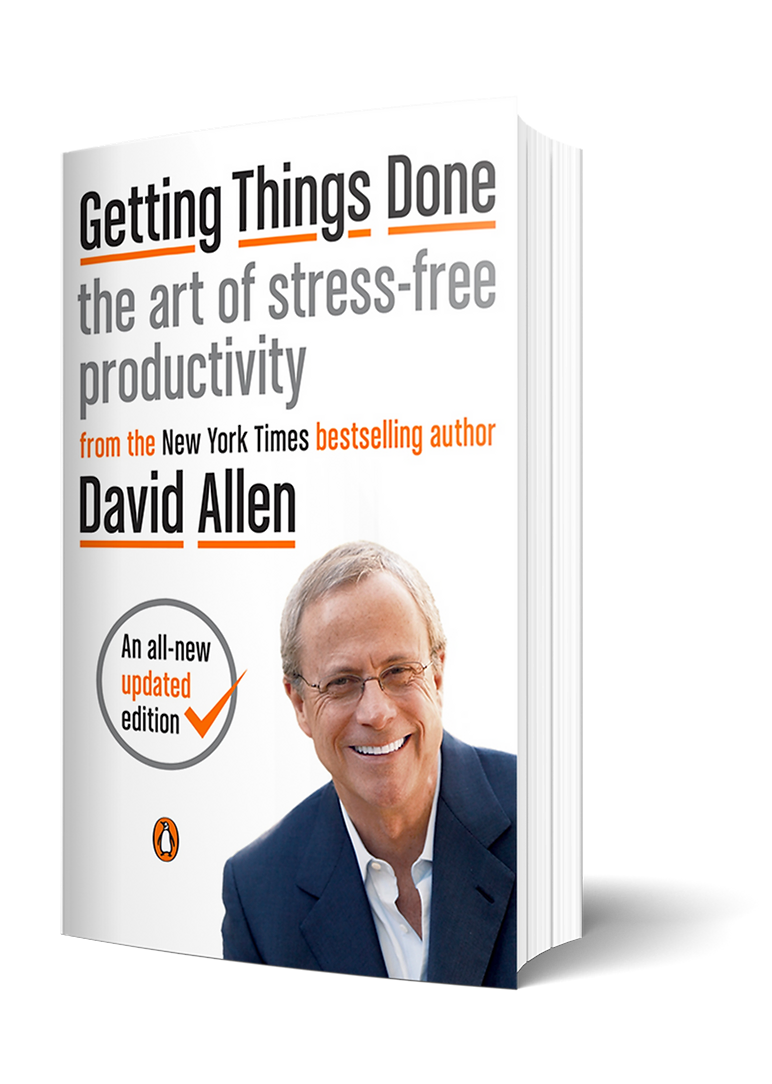
The methodology is documented in full in David Allen's New York Times bestseller, the definitive reference for anyone who wants to go deeper.

The New York Times Bestseller
The Definitive Guide to GTD
Getting Things Done brings together decades of research to introduce a gold mine of productivity tips and strategies for getting a lot more accomplished with much less effort.
The book explains the method. Coaching helps you make it yours.
As an Amazon Associate, GTD Focus earns a small commission from qualifying purchases at no additional cost to you.
Here's What People Say After Implementing GTD
Frequently Asked Questions About GTD
No. A to-do list captures tasks. GTD captures everything, projects, commitments, ideas, someday possibilities, and gives each one a place so nothing competes for your attention at the wrong time.
Many GTD practitioners would tell you they don't label themselves as organized either. The method works because it doesn't rely on memory, willpower, or personality. It relies on structure.
The five steps can be understood in an afternoon. Building the habits and system that make them second nature is where coaching makes a meaningful difference, typically over two to four months.
No. The book is the definitive guide to the methodology, but it's not a prerequisite for coaching. Most clients find that coaching and the book complement each other. The coaching makes the book make more sense, and vice versa.
Most productivity systems tell you how to prioritize. GTD helps you get complete clarity on everything you're managing before deciding what to do next. It's less about doing more and more about being sure you're doing the right things.
Yes. GTD is tool-agnostic, it works with paper, digital apps, or a combination of both. The method is about how you think about and manage your commitments, not which software you use. Part of what coaching does is help you find the right tools for how your mind works most optimally.
The 5 steps of GTD
GTD organizes everything on your mind into five simple steps with each one building toward a system you can trust.
Step 1
Capture
Write, record, or gather any and everything that has your attention into a collection tool.
Step 2
Clarify
Is it actionable? If so, define the next action and project (if more than one step is required). If not, decide whether to delete it, file it as reference, or put it on hold.

Step 3
Organize
Move items into the right place so you can act on them later. For example, create lists for calls to make, errands to run, email to send, etc.
Step 4
Reflect
Regularly review your system to stay clear and in control. A Weekly Review helps you update lists, clean things up, and reset your focus.
Step 5
Engage
Use your trusted system to choose the next action with confidence and clarity.
Beyond the Five Steps: The Higher Horizons of GTD
The five steps give you a system for managing what's on your plate right now. But GTD doesn't stop there.
Once your ground level is clear; your tasks, projects, and next actions are captured and organized, you have the mental bandwidth to look further ahead. GTD describes five horizons of focus that sit above your daily work, each one giving the levels below it more meaning and direction.
Horizon 1 — Projects & Actions
The ground level. The concrete work you're actively moving forward with like tasks with clear next actions and projects with defined outcomes.
Horizon 2 — Areas of Focus & Responsibility
The ongoing domains of your life you're responsible for maintaining such as your health, your team, your relationships, your finances. These are not projects that have an end point, but commitments that continue indefinitely.
Horizon 3 — Goals & Objectives
Where you want to be in the next one to two years. The specific outcomes that give direction to your current projects and responsibilities.
Horizon 4 — Vision
What you want your work and life to look like in the future, before those ideas become formal commitments. This is the space to brainstorm and experiment with the possibility of different ideas.
Horizon 5 — Purpose & Principles
The deepest level. Who you want to be, what matters most to you, and the impact you want to have. When this is clear, every other horizon becomes easier to navigate.
Most people start with the five steps and find that clearing the ground level, getting everything out of their head and into a trusted system, is already transformative. The higher horizons are where that clarity becomes the foundation for something larger.
Understanding GTD is one thing. Applying it is another.
Coaching turns the method into a system you actually use, built for your role, your tools, and the way you think.